Procure Recycled: Paving the Way (Rubber)
In response to China’s 2017 National Sword policy, which effectively barred imports of Australia’s recyclable materials, and the Coalition of Australian Governments’ (COAG) subsequent decision in 2019 to phase in a ban on exports of a range of Australia’s unprocessed recyclable materials, the Southern Sydney Regional Organisation of Councils (SSROC) launched the Procure Recycled: Paving the Way initiative. The aim was to improve the sustainability of council roads, actively develop local markets for recycled materials, and support the development of necessary infrastructure. The waste tyre export ban came into effect on 1 December 2021.
In partnership with and part-funded by Tyre Stewardship Australia (TSA), SSROC coordinated a 12-council demonstration of rubber-modified bitumen asphalt across sites in local government areas in Sydney: Bayside, Burwood, Canada Bay, Canterbury-Bankstown, City of Sydney, Georges River, Inner West, Randwick, Sutherland, Waverley, Woollahra, and Northern Beaches. Each council resurfaced a road section using bitumen modified with rubber recovered from end-of-life car and truck tyres. These were later evaluated for performance, durability, and environmental benefits of recycled rubber in road pavement.
SSROC engaged Australia Flexible Pavements Australia (AfPA) to analyse and gauge the suitability of contractors to meet project objectives, and to develop, in consultation with councils, demonstration asphalt mixes, guidelines, and monitoring parameters based on the expected risks and benefits of recovered rubber in asphalt.
RMIT University’s Professor of Civil and Infrastructure Engineering was engaged to conduct a life cycle assessment of the materials.
All tyre-derived materials used in the project comply with the NSW Environment Protection Authority (EPA) tyre material order and exemption 2014 to ensure they meet regulatory requirements.
SSROC’s Paving the Way (Rubber) project involves incorporating rubber recovered from used tyres into bitumen for asphalt. It aims to:
- improve the sustainability of council roads,
- reduce net capital and operating expenditures by extending road life,
- create a local market for end-of-life car and truck tyres.
The largest demonstration of recovered rubber asphalt done in Australia, the project initially used about 29 tonnes of rubber – about 3,600 equivalent passenger units (EPU) – sourced from Sydney tyre recyclers. A local market for 264,000 used EPUs per annum could potentially be created if participating councils adopt rubber-modified asphalt as standard beyond the demonstration.
The project explored a range of asphalt mixes incorporating varying levels of rubber derived from end-of-life truck and car tyres. The performance of these, in a range of applications and conditions was periodically monitored against control sections to assess performance benefits.
The demonstration project used the wet method to bind recovered rubber crumb rubber to bitumen for asphalt in road pavements. The project was completed in 2025, and initial findings reported, while monitoring is intended to continue to at least 2035.
The project trialled different applications in specific council road resurfacing sites, including:
- Different rubber sources (passenger car tyres vs. truck tyres)
- Different road applications and surface treatments
- Different recovered rubber content levels (9%, 15%, and 18%)
- Rubber-modified bitumen in combination with other recycled materials (recycled glass, reclaimed asphalt pavement)
- Applications in various traffic conditions (residential, busy/light traffic, CBD/suburban roads).
Monitoring after 12-months was done by Infrastructure Management Group (IMG) and AfPA has completed the analysis and evaluation report. The report is available (PtWR 20250207 Demo Projects PART 2 Report FINAL.pdf)[HS1] . In addition, TSA produced a SSROC project case study summary.
Demonstration Site Performance
SSROC’s Paving the Way (Rubber) demonstration showed strong performance benefits. IMG’s monitoring after 12 months has shown promising results. For example:
- Passenger car and truck tyre rubber both performed well, demystifying previous misconceptions that passenger tyre rubber is inferior,
- Compared to conventional asphalt, recovered-rubber asphalt performed better or equally well in at least 80% of applications,
- Reduction in rutting depth of up to 50% in some applications signals a significant boost for road durability,
- Enhanced flexibility and resistance to reflective cracking when applied over concrete pavements.
The full benefits of use of recovered rubber for pavement of the roads will be more robustly proven over the next 1-2 decades, and SSROC currently plans to monitor for up to 10 years.
Life Cycle Assessment
The RMIT University’s Civil and Infrastructure Engineering Professor led the SSROC initiatives’ “Life Cycle Assessment and Potential Environmental Benefits of Crumb Rubber Asphalt using Field Data” study. It explored the environmental impacts associated with modifying bitumen with crumb rubber recovered from end-of-life tyres using the wet method, and incorporating the modified bitumen into for asphalt pavement construction. The study found that the modified material extends pavement service life, reduces demand for raw materials, and lowers environmental impacts.
The graphic illustration below shows the stages and cycle for rubber-modified asphalt from end-of-life tyres.
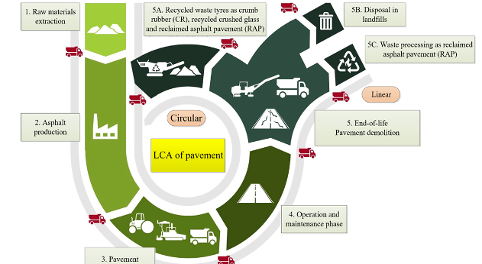
The Life Cycle Assessment of SSROC’s project initiative assessed the carbon footprint (kg CO2-equivalent) and other environmental impacts of production, construction, and maintenance of recycled rubber asphalt pavements. These were then compared to conventional asphalt mix (without recycled rubber) laid at the same location and exposed to comparable traffic and weather conditions.
The study found that incorporating recycled rubber into asphalt mixes using the wet method can reduce environmental impacts, including:
- Adding 10% crumb rubber by weight of the total binder (100 grams of crumb rubber to 900 grams of virgin bitumen to manufacture 1 kg of rubber-modified binder) resulted in lower environmental impacts compared to using 1 kg of conventional bitumen, leading to reduced emissions during the construction phase.
- Recovered rubber asphalt demonstrates durability and resistance to cracking, rutting, and ageing. This entails less frequent maintenance and longer-lasting pavements. The sensitivity analysis shows significant carbon footprint reductions (5.6% to 27.3%) with a 10-40% extension of pavement service life due to crumb rubber.
- Environmental impacts reduction of up to 30% has been associated with the maintenance phase of the road asset.
- Indirect environmental benefits include:
- the opportunity to recover steel from end-of-life tyres during crumb rubber production
- diverting waste tyres from landfills.
- These further decrease greenhouse gas emissions associated with using rubber-modified asphalt.
- Incorporating recycled end-of-life tyre material into bitumen reduces the demand for virgin materials, lowering the carbon footprint of production.
- Combined with Reclaimed Asphalt Pavement (RAP) material yields further substantial environmental savings.
- Recovered rubber asphalt pavements require fewer maintenance activities due to improved durability, weather resistance, reduced rutting, and enhanced cracking resistance.
Professor Filippo Giustozzi who led the lifecycle assessment observed that this can potentially offset the environmental impacts generated by new road construction and ongoing maintenance operations and overall lead to the decarbonization of the road infrastructure.
———————–
“The SSROC demonstration project was a resounding success, showcasing the collaborative efforts of councils, industry associations, asphalt contractors, bitumen suppliers, and product stewardship organisations. This project – undeniably of national significance – stands as one of the few of its kind both in Australia and globally”.
- Australian Flexible Pavement Association, May 2025
“Roads are the largest assets for local governments and one of our best opportunities to move towards a circular economy. First glass, and now recycled rubber, councils are maximising the benefits of waste-derived resources in line with the community’s expectations for government-driven sustainability”.
- SSROC President and Mayor Burwood Council, Cllr John Faker
“As 85% of Australia’s roads are managed by local councils, the SSROC project demonstrates the value of local governments driving circular economy outcomes by using tyre-derived material across roads and civil infrastructure projects”.
- Tyre Stewardship Australia Chief Executive Officer, Lina Goodman